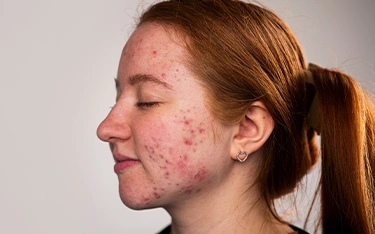
Acne is a common inflammatory skin condition that can appear as blackheads, whiteheads, red bumps, pus-filled pimples or deeper painful lumps. Understanding the types of acne matters because different lesions behave differently, carry different risks of scarring and may require different approaches to treatment.
Acne vs pimples is essentially the difference between a skin condition and one of its symptoms. Acne is the broader inflammatory disorder involving the hair follicle and oil gland. A pimple is an individual acne lesion.
Acne can affect teenagers and adults and commonly appears on the face, chest, shoulders and back. Hormones, excess oil production, blocked follicles, inflammation, genetics, skincare products, stress and lifestyle can all influence breakouts.
Someone with acne may have several lesion types at the same time:
- blackheads;
- whiteheads;
- papules;
- pustules;
- nodules;
- deeper cyst-like lesions.
This distinction matters because a few occasional surface pimples are very different from persistent inflammatory or nodular acne. The type, number, depth and location of lesions—as well as whether they are leaving dark marks or scars—help determine how acne should be managed.
At Dr Batra's UAE, acne care starts by identifying what type of acne is present, how severe it is and what may be keeping it active. This allows treatment to be personalized rather than relying on trial-and-error products. Not sure which type of acne you have? Book a skin consultation with Dr Batra's UAE.
What Causes Acne: The Four-Factor Mechanism and Its Triggers
If you are wondering what causes acne, research points to four interacting processes:
- Excess or altered sebum production from the skin's oil glands.
- Abnormal build-up of skin cells that blocks the follicle.
- Changes involving Cutibacterium acnes, bacteria naturally present on the skin.
- Inflammation within and around the follicle.
Several factors can then influence how strongly these mechanisms affect an individual, including:
- hormonal changes;
- family history;
- stress;
- oily or pore-clogging cosmetics;
- certain hair products;
- friction and occlusion;
- sweating;
- individual skin characteristics.
Acne is not simply caused by dirty skin. Excessive washing or aggressive scrubbing can irritate the skin barrier without addressing the processes occurring inside the follicle.
Types of Acne: Non-Inflammatory and Inflammatory Lesions Explained
The main types of acne can be divided into non-inflammatory and inflammatory lesions.
| Category | Acne Type | Typical Appearance |
|---|
| Non-inflammatory | Whiteheads | Closed, skin-coloured or pale bumps caused by blocked follicles |
| Non-inflammatory | Blackheads | Open clogged follicles with dark surfaces caused by oxidation, not dirt |
| Inflammatory | Papules | Small, raised and inflamed bumps without visible pus |
| Inflammatory | Pustules | Inflamed pimples with a visible white or yellow centre |
| Inflammatory | Nodules | Deep, firm and often painful lumps beneath the skin |
| Inflammatory | Cyst-like lesions | Deep, tender lesions with a greater risk of scarring |
Blackheads and whiteheads are generally considered comedonal acne. Papules and pustules indicate greater inflammation.
Nodules and deep cyst-like lesions deserve earlier professional assessment because inflammation extends further into the skin and carries a higher risk of permanent scarring.
Many patients have a combination of different acne types, which is another reason one universal product may not be enough.
Acne by Location: What Your Breakout Pattern Suggests
The location of acne can sometimes provide useful clues, but online “face mapping” should not be used to diagnose problems with internal organs.
Forehead and hairline
Hair oils, styling products and other pore-clogging products can contribute to breakouts around the forehead and hairline.
Chin and jawline
Persistent lower-face acne in adult women can sometimes have a hormonal component, particularly when breakouts change with the menstrual cycle.
However, jawline acne alone does not diagnose a hormonal disorder.
Cheeks
Friction, makeup, touching the face and occlusive equipment may aggravate cheek acne in susceptible skin. There is no reliable rule linking cheek acne to one particular internal health condition.
Chest and back
These areas contain many oil glands. Sweat, tight clothing, friction and occlusion can contribute to body acne.
Location is therefore best treated as one piece of the clinical picture, alongside lesion type, timing, severity and hormonal or lifestyle patterns.
Hormonal Acne and the PCOS Connection
Hormones play an important role in acne because androgen activity can influence oil glands and follicular behaviour.
Hormonal acne may be suspected when adult women experience:
- persistent chin or jawline acne;
- breakouts that worsen around the menstrual cycle;
- irregular periods;
- unwanted facial or body hair;
- scalp hair thinning;
- other signs of androgen excess.
PCOS—now also referred to as Polyendocrine Metabolic Ovarian Syndrome (PMOS) following the 2026 international terminology update—is one condition associated with androgen-related acne.
However, having acne does not mean someone has PCOS/PMOS.
When persistent acne occurs alongside menstrual irregularity, facial hair or scalp thinning, professional evaluation may help determine whether there is a broader hormonal pattern. Persistent acne with irregular periods or hair changes? Consult Dr Batra's UAE for a personalised evaluation.
When to See a Doctor for Acne
Professional assessment becomes particularly important when:
- acne repeatedly returns;
- pimples are deep or painful;
- scars or persistent dark marks are developing;
- breakouts continue into adulthood;
- acne occurs alongside hormonal symptoms;
- self-care has not produced adequate improvement.
If any of these sound familiar, don't wait, book your acne consultation with Dr Batra's UAE today.
How Acne Is Assessed at Dr Batra's UAE ( AI Skin Tool ) Detailed report
At Dr Batra's UAE, acne assessment combines a detailed consultation with AI-assisted skin analysis. The AI Skin Pro scans the face from several angles and looks beneath the surface at features such as oil production, pores and pigmentation. The doctor reads these findings alongside your history, so your plan is based on what is actually happening in your skin and not on guesswork.
Want to see what is happening beneath your acne? Book an AI-assisted skin assessment with Dr Batra's UAE.
Acne and Pimple Homeopathic Treatment
At Dr Batra's UAE, your consultation starts with understanding your acne: its type, how severe it is and how long it has been present, along with any marks, scars or pigmentation it has left. The doctor also asks about your hormonal and menstrual patterns, stress, sleep, diet and lifestyle, and the skincare products and treatments you have already tried. Where appropriate, AI-assisted skin analysis adds a closer look at your skin, so your treatment plan is built around what is actually driving your breakouts.
Advantages of homeopathic medicines
- Personalised: the plan is based on your acne pattern, triggers and overall health, not one standard prescription.
- Looks at the cause: it aims to understand why breakouts keep returning, not just to settle one pimple.
- Non-invasive and gentle: it uses oral medicines, and it can be combined with skincare guidance.
- Personalised treatment plan : it takes stress, lifestyle and hormonal patterns into account and create a plan that is designed to cater to your specific needs and type of acne
Acne rarely has a single cause, and treating only the visible pimple often brings it back. Lasting improvement comes from understanding why your skin keeps breaking out, whether that is oil production, inflammation, products, stress or hormonal patterns.
At Dr Batra's UAE, your acne treatment begins with a detailed consultation and AI-assisted skin analysis, so your plan is built around your acne type, skin and lifestyle. For acne linked to hormonal patterns, such as jawline breakouts or breakouts that change with your cycle, treatment looks at the whole picture. It combines personalised homeopathic care with practical guidance on diet, sleep and stress, so your skin is supported from the inside as well as the outside.
Acne is treatable, and you don't have to keep guessing which product to try next. The sooner you get the right assessment, the sooner you can start protecting your skin from marks and scars.Ready for clearer, healthier skin? Book your consultation with Dr Batra's UAE today.
Lifestyle tips and Products to Avoid
Even a good treatment plan can struggle if everyday habits continuously irritate acne-prone skin.
Try to avoid:
- squeezing or popping pimples;
- frequently touching the face;
- harsh facial scrubs;
- excessive cleansing;
- introducing several strong products at once;
- sleeping in makeup;
- pore-clogging cosmetics;
- allowing heavy hair oils or styling products onto acne-prone facial skin;
- repeatedly rubbing acne with helmets, straps or tight clothing.
In the UAE, sweating can be another consideration. Heat does not directly cause acne, but a combination of sweat, oil, makeup, sunscreen and occlusion can aggravate breakouts in susceptible skin.
Acne-prone skin still needs sunscreen. The better solution is choosing an appropriate formulation rather than avoiding UV protection.






 Call Now