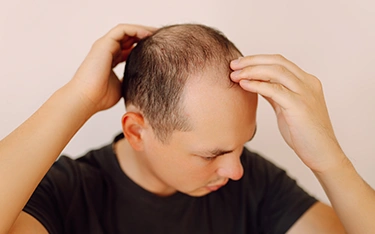
A receding hairline does not always mean you are going bald. Some men develop a mature hairline that remains stable, while continued temple recession, crown thinning or increased scalp visibility may indicate male pattern baldness.
Doctors commonly assess this pattern using the Norwood Scale, also known as the Hamilton-Norwood Scale. It classifies male pattern hair loss into seven stages, ranging from minimal recession to extensive hair loss across the top of the scalp.
Knowing your stage helps describe the pattern of hair loss, but it does not predict how quickly it will progress or which treatment will work best. This depends on factors such as follicular miniaturisation, progression and the number of active follicles remaining.
What Is the Norwood Scale and Why Do Doctors Use It?
The Norwood Scale is a clinical system used to classify androgenetic alopecia in men. It assesses hair loss across the frontal hairline, temples, mid-scalp and crown.
Doctors may use it to document the pattern, monitor changes over time and guide treatment discussions. However, the stage alone does not determine treatment, as two people at the same stage may have very different levels of follicular activity.
The Hamilton-Norwood Scale: Where Did It Come From?
The scale builds on the work of physician James Hamilton and was later refined by dermatologist O'Tar Norwood in 1975. Norwood described seven main patterns of male baldness, which became known as the Hamilton-Norwood Scale.
It remains a widely used clinical reference for male pattern hair loss, but it should be used as a guide rather than a self-diagnosis, as hair loss progression can vary significantly from person to person.
What Causes Male Pattern Baldness?
Male pattern baldness, medically known as androgenetic alopecia, is influenced by genetic susceptibility and androgen activity.
In susceptible follicles, the hair-growth cycle gradually changes. The follicles become smaller, a process known as follicular miniaturisation, and begin producing finer, shorter hairs that provide less scalp coverage.
Research shows that androgenetic alopecia has a complex, polygenic basis rather than one single "baldness gene". The belief that baldness comes only from the mother's side is therefore an oversimplification.
The typical pattern affects the temples, frontal scalp, mid-scalp and crown, while hair around the sides and back is often relatively better preserved.
This matters because a miniaturised but active follicle is different from a long-standing bald area with little useful follicular activity. Earlier assessment can help establish what options remain.
Early Signs of Male Pattern Baldness
Possible early signs include:
- gradual recession at both temples
- an increasingly M-shaped hairline
- reduced density behind the frontal hairline
- thinning at the crown
- greater scalp visibility
- finer hairs appearing in areas that were previously denser
Comparing photographs taken several months apart under similar lighting is more useful than relying on one image.
Magnified scalp examination can also identify less obvious changes. A 2024 systematic review of 34 studies involving 2,860 patients with androgenetic alopecia found hair-diameter variability, vellus hairs and other trichoscopic features to be common findings.
Noticing these signs? Meet a Senior Consultant at Dr Batra's UAE for a magnified scalp assessment.
The 7 Stages of Hair Loss in Men
The 7 stages of hair loss on the Norwood Scale describe increasingly extensive patterns of male pattern baldness.
| Stage | Pattern of Male Pattern Baldness |
|---|
| Stage 1 | Little or no significant recession. Does not mean a person will inevitably develop baldness. |
| Stage 2 | Mild recession around the temples; hairline may become slightly M-shaped. For some men this stays a stable adult hairline, for others it may be the start of progressndrogenetic alopecia. |
| Stage 3 | More obvious temple recession, generally representing established male pattern baldness in the traditional classification. A variation, Stage 3 Vertex, includes mrominent crown thinning. |
| Stage 4 | Deeper frontal recession with a clearer area of crown thinning. A band of relatively denser hair usually remains between the two areas. |
| Stage 5 | Frontal and crown areas become larger and the band separating them becomes narrower. Assessment of remaining follicular activity becomes increasingly important. |
| Stage 6 | Frontal and crown areas merge, creating a larger continuous region of hair loss across the top of the scalp. |
| Stage 7 | Most advanced classic stage. Most hair across the frontal scalp, mid-scalp and crown is lost, with a narrower band remaining around the sides and back. |
Not sure which stage you're at? Meet a Senior Consultant at Dr Batra's UAE to understand your pattern of hair loss.
How Fast Does Male Pattern Baldness Progress?
There is no fixed timeline. Some men remain at an early stage for years, while others progress more quickly. Genetics, age at onset, androgen sensitivity and follicular miniaturisation can influence the course.
The Norwood Scale describes the pattern now; it does not predict where your hairline will be in five years. Claims such as "Stage 2 becomes Stage 3 within two years" are not medically reliable.
Also Read: Is Male Pattern Baldness Stoppable?
Can Male Pattern Baldness Be Treated or Reversed at Every Stage?
Treatment can be considered at different stages, but complete reversal should never be promised.
When miniaturised follicles are still active, there may be greater opportunity to preserve existing hair or improve density. When an area has remained completely bald for a long time and useful follicular activity is very limited, meaningful non-surgical regrowth becomes less likely.
A doctor may therefore look at:
- Norwood stage
- current density
- follicular miniaturisation
- rate of progression
- scalp health
- age and family history
- previous treatment
- donor hair where relevant
- treatment expectations
Earlier assessment does not automatically mean treatment is needed. It helps answer three questions: Is this male pattern baldness? Is it progressing? Are active follicles still present? Want to know if active follicles remain? Meet a Senior Consultant at Dr Batra's UAE to find out
Treatment Options: Benefits and Limitations
| Approach | Potential role | Important considerations |
|---|
| Individualised clinical management | May help preserve existing hair and manage progression | Requires proper assessment and follow-up |
| Low-level light-based treatment | Research supports potential improvements in density in selected patients | Results vary and devices/protocols differ |
| Non-surgical scalp procedures | May support hair where viable follicles remain | Suitability depends on individual assessment |
| Hair transplantation | Can redistribute donor follicles to areas of established loss | Surgical; requires adequate donor hair and careful selection |
| Cosmetic solutions | Can improve the appearance of scalp coverage | Do not change the underlying androgenetic process |
A randomised, double-blind, sham-controlled trial of low-level light therapy reported greater hair-density improvement in the active-treatment group after 16 weeks. Results from one device or protocol, however, cannot be assumed for every patient. Unsure which hair treatment option suits you? Meet a Senior Consultant at Dr Batra's UAE for a personalised plan.
Male Pattern Baldness Treatment at Dr Batra's UAE
At Dr Batra's UAE, male pattern baldness treatment starts with understanding the individual rather than treating the Norwood stage in isolation.
The consultation considers when hair loss started, its progression, family history, scalp condition, lifestyle factors, previous treatments and the extent of thinning. Where appropriate, magnified scalp assessment or video microscopy may also be used.
Homeopathy is used as a personalised approach to support hair and scalp health by considering underlying physical, emotional and lifestyle factors that may contribute to hair fall. It aims to help reduce excessive hair fall, support existing follicles and improve overall scalp health, using gentle medicines prescribed under expert supervision.
Where clinically appropriate, homeopathic care may also be combined with suitable non-surgical aesthetic hair treatments. The final plan is selected after assessment, with the aim of understanding the pattern of hair loss, evaluating remaining active follicles and creating a personalised hair fall treatment plan.
Advance Hair Treatments that can help with Male pattern baldness:
HairGain:
Dr Batra's® HairGain is an advanced hair regrowth treatment powered , a potent formula with copper tripeptide, growth factors, polypeptides, and essential amino acids. Newly launched in the UAE, HairGain penetrates up to the 3rd layer of the scalp to regenerate damaged follicles, delay follicle ageing, and nourish hair from the root
GroHair:
Hair thinning and hair fall occur due to weak follicles, poor scalp circulation, and nutritional imbalance. At Dr Batra's®, groHair treatment addresses these root causes using advanced, non-surgical technology, helping strengthen follicles, improve scalp circulation, and support natural hair regrowth over time.
Meet a Senior Consultant at Dr Batra's UAE to understand your stage of hair loss, assess your scalp and follicles, and discuss which treatment options may suit you.
Medical disclaimer: This article is for general educational information and does not replace individual diagnosis, medical advice or consultation with a qualified healthcare professional. Treatment suitability, response and outcomes vary between individuals.








 Call Now