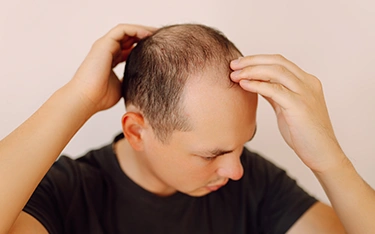
A higher hairline does not automatically mean baldness. In many men, the hairline shifts slightly after adolescence and then stays stable. A receding hairline, by contrast, keeps moving backwards and may be an early sign of androgenetic alopecia, or male pattern hair loss.
The key difference is not forehead height. It is whether the hairline is stable or progressively changing, whether hairs at the temples are becoming finer, and whether density is also reducing elsewhere.
What Is a Mature Hairline?
A mature hairline is a commonly used term for a hairline that has moved slightly from its adolescent position and then stabilised. It is not a formal medical diagnosis, and there is no universally accepted measurement for it.
Typically, the change is mild, relatively symmetrical and not accompanied by continuing loss of density behind the hairline.
What Is a Receding Hairline?
A receding hairline is progressive backward movement of the frontal or temporal hairline.
In men, a common cause is androgenetic alopecia. In genetically susceptible follicles, androgen-related changes lead to follicular miniaturisation. Over time, affected hairs become finer and shorter and provide less scalp coverage.
Recession often starts at the temples and may develop into a deeper M-shaped pattern. Thinning can also appear across the frontal scalp or crown.
Mature vs Receding Hairline: Key Differences
| Feature | Mature Hairline | Receding Hairline |
|---|
| Change over time | Usually stabilises | Continues moving backwards |
| Temples | Mild, fairly even recession | Recession becomes deeper |
| Hair thickness | Density stays relatively good | Hairs near the edge may become finer |
| Crown | Usually unchanged | Thinning may develop |
| Pattern | Subtle and stable | Increasingly patterned loss |
Not sure which pattern you have? Meet a Senior Consultant at Dr Batra's UAE for a professional hair and scalp assessment.
How to Tell the Difference: Quick Self-Check
Finger-width test
There is no medically validated rule that defines a mature or receding hairline by a fixed number of finger widths. Natural forehead size and hairline position vary between people.
Compare photographs over time
Compare photographs taken six to twelve months apart in similar lighting and from the same angle. Progression is more useful than one image.
Look for thinner hairs at the temples
Increasing numbers of short, fine hairs around the hairline can be consistent with follicular miniaturisation.
When should you see a doctor?
Consider an assessment if the hairline keeps changing, density falls, shedding becomes unusually heavy, or hair loss occurs with bald patches, scaling, redness or pain.
Receding Hairline in Men vs Women
Men with androgenetic alopecia commonly develop frontotemporal recession together with thinning over the top of the scalp.[1]
Women more often develop diffuse thinning across the central or upper scalp, with the frontal hairline relatively preserved, although bitemporal recession can occur.
A woman with noticeable frontal recession should therefore not automatically assume that the cause is the same as male pattern hair loss.
If your hairline is changing, book a senior doctor consultation at Dr Batra's UAE for an individual hair and scalp assessment.
Causes of Hairline Thinning Beyond Genetics
Not every thinning hairline is genetic.
Other possibilities include:
- repeated tension from tight hairstyles
- significant stress or illness followed by increased shedding
- nutritional deficiencies
- thyroid or other hormonal disturbances
- scalp inflammation
- certain scarring forms of hair loss
Repeated pulling on the hairline can cause traction alopecia and, if it continues for a prolonged period, may eventually result in permanent hair loss.
That is why identifying the cause before choosing a hair fall treatment matters.
Can a Mature Hairline Become Receding? Can a Receding Hairline Be Treated?
Yes. A person can first develop a stable adult hairline and later develop progressive androgenetic alopecia.
The important clue is new change: deeper temple recession, reduced density, finer hairs around the hairline or thinning at the crown.
A receding hairline can often be managed, but realistic outcomes depend on the cause and whether viable follicles remain.
Miniaturised but active follicles may have more potential for improvement than areas that have been completely bald for a long time. This is one reason assessment before advanced hair loss develops can be useful.
Book a free consultation at Dr Batra's UAE and ask whether AI Hair Pro analysis is appropriate for your hairline concern.
Treatment Options at Dr Batra's UAE
At Dr Batra's UAE, hair-loss care starts with assessment rather than selecting a treatment simply because your hairline resembles an image online.
The consultation can consider the pattern and duration of hair loss, family history, scalp condition, lifestyle factors and previous treatment.
Dr Batra's UAE also offers AI Hair Pro, which uses high-definition cameras, specialised lighting and high-magnification imaging to examine the hair and scalp. The analysis can provide information about features such as hair density and thickness and can be used to support personalised treatment planning and progress monitoring.[6]
Homeopathy
Dr Batra's uses individualised homeopathic care as part of its broader approach to hair and scalp concerns.
For genetically driven androgenetic alopecia, homeopathy should not be presented as a guaranteed way to recreate follicles in long-standing bald areas. Published evidence specifically establishing homeopathy as an effective treatment for androgenetic alopecia remains limited.
At Dr Batra's UAE, homeopathic care may form part of an individualised plan together with suitable non-surgical options after assessment.
Advanced Hair Treatment
Dr Batras also provides non-surgical advanced hair treatment along with Homeopathy that helps in hair growth , reducing thinning etc. For Example -
HairGain:
Dr Batra's® HairGain is an advanced hair regrowth treatment powered by a potent formula with copper tripeptide, growth factors, polypeptides, and essential amino acids. Newly launched in the UAE, HairGain penetrates up to the 3rd layer of the scalp to regenerate damaged follicles, delay follicle ageing, and nourish hair from the root
GroHair:
Hair thinning and hair fall occur due to weak follicles, poor scalp circulation, and nutritional imbalance. At Dr Batra's®, groHair treatment addresses these root causes using advanced, non-surgical technology, helping strengthen follicles, improve scalp circulation, and support natural hair regrowth over time.
Oxy HVT:
Next Gen medically approved treatment to reduce hair loss and increase terminal hair density in both males and females in just 10 weeks.
Meet a Senior Consultant at Dr Batra's UAE and ask whether AI Hair Pro analysis is appropriate for your hairline concerna







 Call Now